Dark Patterns: How Apps, Games, Website and Online Stores get us addicted and how it is worse for people with ADHD and ASD
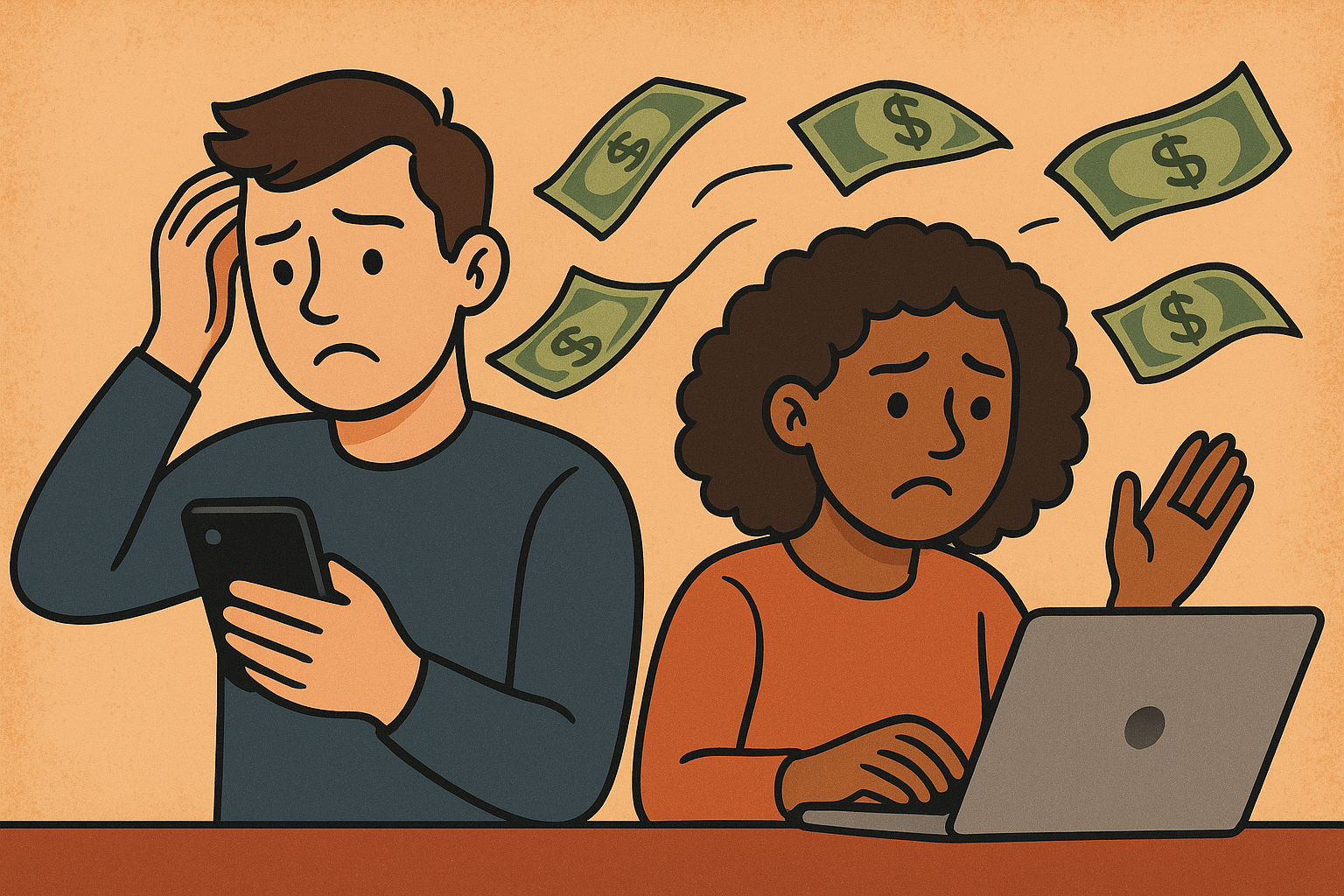
Image Curtesy of ChatGPT “make an image for a blog post related to dark patterns in games and websites. Include pictures of people looking confused as they use technology and money flying away from them.”
Dark Patterns Are All Around Us
When I heard on the news yesterday that Amazon had settled a lawsuit with the Federal Trade Commission for $2.5 billion dollars, I stopped what I was doing and listened. It’s pretty rare for one of the most valuable companies in the world to settle a lawsuit with the FTC, and even more rare for them to spend so much to do it. It turns out that the FTC has sued Amazon for many deceptive practices, such as making it appear a customer needed to sign up for their premium Amazon Prime membership before making some purchases, making canceling Amazon Prime Membership difficult and confusing, and other less than honest business practices.
During the investigation, the FTC pointed out internal Amazon documents in which Amazon employees recognized that many customers didn’t know they had Prime or didn’t understand cancellation—and that simplifying cancellation led to more people quitting Prime, which was bad for Amazon’s revenue.
I was glad to see a company being called out on this. Amazon did not admit guilt in the case, but at some level, Jeff Bezo’s team must have felt paying a $2.5 billion dollar fine was better than going to court, and that says something. That a major company was held accountable for high tech deceptive business practices is good news for consumers.
The bad news is that these types of practices, called Dark Patterns, are everywhere online. They are in the apps on our phone, the games in our Nintendo Switches and Xboxes, online stores, and websites. Dark patterns have many goals, but fundamentally, they are designed to make money. Some of them make it difficult for us to quit a subscription. Some of them make us want to log into to a “free” game or app so often we start spending money there. All of them are designed to be hidden and make us feel like the decision to pay a company or person was our choice. But they are an example of how our own minds can be hacked to the benefit of others and the detriment of ourselves.
Everyone needs to know about dark patterns. They’re designed to take advantage of the way our brains work—and for some people, especially those with ADHD (Attention-Deficit/Hyperactivity Disorder) or ASD (Autism Spectrum Disorder), these tricks can be especially powerful.
Here is a basic summary of what dark patterns are and how they work.
Dark Patterns: How Apps, Games, and Websites Hook Our Brains
When you go online, open an app, or play a video game, you probably expect to make your own choices. But what if the design of those platforms is quietly steering you in a direction you didn’t choose? That’s where dark patterns come in.
Dark patterns are tricks built into the design of websites, apps, and games that push people to spend more time, more attention, or even more money than they intended. These tricks can look harmless at first: a flashing button, a “limited-time offer,” or an endless scroll of content.
What Are Dark Patterns?
A dark pattern is any design choice that makes it easier to do what the company wants—and harder to do what you want. Some common examples include:
Infinite scroll: instead of a page ending, content keeps loading endlessly. Without natural stopping points, it’s much harder to put your phone away.
Season Pass: A common feature in many games, in which players who pay additional money are rewarded for a set amount of time with in-game items and other content. Season passes usually last a few weeks and need to be renewed each season.
Sunken Cost: A feeling video games, customer reward programs for credit cards and airlines, and other programs use to keep customers with their product. Customers are intended to feel that they have built up so many levels or items in a game or reward program that they would be effectively punished if they stopped playing or if they switched to another product or provider.
Loot boxes / gacha mechanics: games let you buy a mystery box or “wish” for a random reward. Sometimes the odds of getting something rare are very low, but the design makes you think “maybe the next one will be it.”
Fake urgency / scarcity: “Only 1 left!,” “Deal ends in 5 minutes!” or limited-time events make you panic and act quickly without thinking.
Streaks / daily rewards: reward systems that push you to log in every single day so you don’t lose a “streak,” even if you don’t really want to at that moment.
“Nagging” pop-ups / confirm-shaming: pop-ups that appear repeatedly telling you “Do you really want to leave?” or making “No thanks” hard to find, or wording it so that choosing “No” feels like you’re giving up something.
Obscured cancellation paths (“cancellation maze”): making it simple to subscribe or sign up, but making it long, confusing, or buried in menus to cancel.
These tricks keep you engaged, returning, often spending more than you planned, or staying in subscriptions you meant to quit.
Why People with ADHD and ASD Are More Susceptible
Everyone can get caught in these traps, but people with ADHD and ASD often face extra challenges:
ADHD and dopamine: Brains with ADHD often crave quick rewards, excitement, novelty. Features like surprise rewards, limited-time offers, flashy graphics, or unpredictable loot can give quick hits of dopamine, which can make disengaging harder.
ASD and deep focus / pattern focus: Many people on the spectrum love routines, patterns, collecting items, completing tasks, achieving goals. Gamified design—streaks, collectables, reward schedules—can become extra compelling.
Difficulty with stopping and self-monitoring: Dark patterns appeal to or exploit weaknesses in noticing when something is over (e.g. fatigue, emotional overload, “just one more”). Undeclared renewal, automatic subscriptions, subtle opt-ins make it easy to lose track.
Real-World Examples in Games & Apps
Here are some specific, well-known cases showing how dark patterns have been used, especially in games, and how regulators have responded.
Fortnite (Epic Games)
The FTC brought a case against Epic Games (“Fortnite”) for using dark patterns in billing. One alleged trick: letting users (including minors) make purchases with a saved credit card without needing to reenter verification, which makes it easier to accidentally buy stuff.
Another example: buttons to preview items placed very close to purchase buttons, so it’s easy to misclick and buy when you only meant to look.
Epic also allegedly made getting refunds or handling unauthorized charges difficult. In some cases, accounts were locked when parents disputed charges.
In total, Epic paid about $245 million in refunds plus additional penalties to settle the matter.
Genshin Impact (Hoyoverse / Cognosphere)
The FTC charged that Genshin Impact used loot box / gacha mechanics that were deceptive: children under 16 could buy loot boxes without proper parental consent; the odds of getting rare items were not clear; there were multiple virtual currencies which make it harder to see “how much real money does this cost.”
Hoyoverse agreed to a settlement of $20 million, and to make changes: more transparency, age-gates, parental consent, clearer disclosure about rewards and costs.
Why These Examples Matter Especially for ADHD / ASD
Combining the real-world examples above with the vulnerabilities associated with ADHD / ASD helps explain how serious dark patterns can be:
In Fortnite, the misclick problem (very close buttons, preview vs. buy being confusing) is especially risky for people who are impulsive or have trouble with precision (which can happen with ADHD).
Loot box systems (as in Genshin Impact or Battlefront II) involve randomness and delayed rewards. For someone with ADHD or ASD, the salience of a rare item, the excitement of “maybe this pull will hit,” can become especially compelling, and harder to resist.
Subscription traps and cancellation mazes (as alleged in Amazon’s case) exploit difficulties in executive functioning—the ability to plan, stop, decide, follow through, or to notice that something is misleading. For someone with ASD especially, changes or unclear boundaries (e.g. ambiguous wording) may cause confusion, and they may stick with what feels familiar or safe (even if costly) rather than fight through confusing cancellation paths.
What Can We Do?
Knowing how dark patterns work—and seeing how they’ve already caused legal action—helps us protect ourselves. Some strategies:
Read carefully all subscription or trial offers, especially the fine print (terms of auto-renewal, cancellation procedure).
Turn off saved payment methods when possible, or require confirmation before purchases.
Use parental controls or age-gating features if available.
Set timers or use apps that limit time spent in games or certain app features.
Be critical of “limited time” or “only one left” messages—they’re often marketing tactics, not truth.
Final Thought
Dark patterns aren’t just abstract design theory—they have real effects. Games like Fortnite and Genshin Impact, big platforms like Amazon, have already been challenged (and in some cases fined) for using them. Especially for people with ADHD or ASD, who can be more sensitive to reward, impulsivity, and difficulty with ambiguity, these tricks can cause serious harm. By staying aware and demanding clearer, fairer practices, we can push for digital spaces that respect choice rather than exploit weakness.
David Nathan, MBA, PsyD, LP
I offer ADHD and ASD testing in St. Paul, MN. I would love to help you or a loved one if you are seeking an ADHD or ASD evaluation. For more information, please call me at (651) 337-3944 or fill out my contact form.
Disclaimer:
This site is for information only. It is not therapy. This blog is only for informational and educational purposes and should not be considered therapy or any form of treatment. We are not able to respond to specific questions or comments about personal situations, appropriate diagnosis or treatment, or otherwise provide any clinical opinions. If you think you need immediate assistance, call your local emergency number or the mental health crisis hotline listed in your local phone book. Use of this blog establishes your consent to the provisions of this disclaimer.
